If There Isn't a Problem, It Isn't a Boat
We limped into Norfolk with a sagging Freedom Lift sort of held up by a retired bow line and barely holding our dinghy out of the water. In Belhaven, I had noticed a slight slick
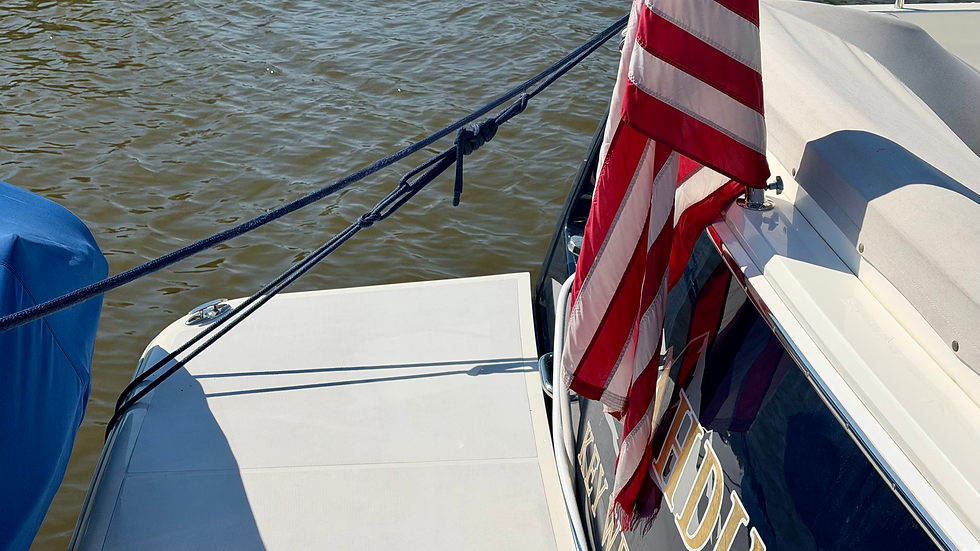
of oil next to the boat but assumed it was coming from the ancient trawler behind us. Imagine my shock when, after slow passing the sailing vessel, Terrapin, they radioed me to say our dinghy was being dragged sideways in the water. Fortunately, we got one lift out of the Freedom lift before it quit altogether with a large spurt of hydraulic oil. Perhaps even more fortunately, Freedom Lift uses Lubriplate Marine-Safe, 32, a biodegradable, non-toxic to marine life hydraulic fluid. I don't have to feel envrionmentally guilty. Using the trucker's hitch that my Dad taught me as a teenager, I fashioned a line to the weak side arm in an effort to keep the limp member from sagging further. As I wrote this, we were imnpatiently awaiting a call from a marine yard 12 miles away in Hampton, VA, that hopefully could haul us, diagnose the problem, and fix it. More on that below.
All that said, coming into Norfolk along the ICW, you pass dozens of Navy ship yards with every kind of naval vessel you can imagine in for repairs and maintenance. I guess the hundreds of millions of dollars being spent to maintain, repair, and upgrade these ships puts my problems in perspective.


Even with our problems in perspective, I'll do anything I can (and a lot of preventive maintenance) to hold off the inevitable failures. I even kissed this mermaid but the admiral said that photo was too weird to include in a blog. Turns out I could have kissed
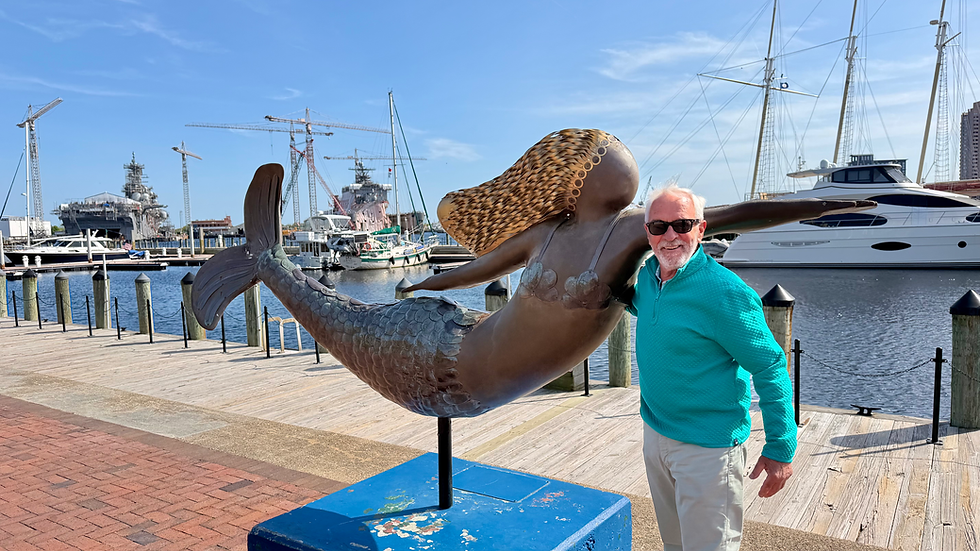
a lot of mermaids. There are 123 mermaids like this one scattered around Norfolk--all painted differently and some even topless.
Problems aside, we had three good days heading north to Norfolk. As we traveled from Beaufort to Belhaven, Belhaven to Coinjock, and Coinjock to Norfolk, we observed numerous Bald Eagles, dozens of Osprey couples sitting on eggs (further south they were already raising young), numerous terns, cormorant, and laughing gulls, fewer and fewer pelicans, and our first Canadian Goose. We're also starting to see more and more ducks. Sadly, we may now really be north of the dolphins. We miss their curious visits and explorations of our bow waves.
Surprisingly, this stretch of the ICW still has a number of low bridges that have not been replaced by the typically 65' high fixed bridge structures. Passing through several bridges each day adds both time and enjoyment to the journey. Most bridge tenders are friendly, helpful and courteous and some are humorous as well. Waiting for an opening also gives you a chance to check out the other boats making the same journey and to chat a bit with their captains and crews.

At the Great Bridge, we also had to navigate the Great Bridge Lock. Having traveled through 177 locks on our Great Loop journey, this was the fist time that a lock keeper squeezed us into a lock with a tug and barge. Watching the tug and barge swing back and forth from one side of the lock to another as it entered the lock did not warm the cockles of my heart about being tied alongside. Originally, the lock keeper had in mind that we would go all the way forward between the barge and lock wall. There's an outside chance we might have fit with inches to spare on each side. However, I was not confident that we nor the barge would not be buffeted as the lock emptied and I stopped alongside the much narrower tugboat. Even then the lock keeper pulled us a bit more forward in order to fit more boats behind us. At the end of the day, when we'd been lowered, the tug pushed the barge ahead of us and we exited the lock in its wake.

After our mid-afternoon arrival in Norfolk on Sunday, we took advantage of the later part of the day to quickly explore the USS Wisconsin, an Iowa class battleship commissioned in 1944 that served in WW II, Korea and the Gulf War before becoming a museum ship in Norfolk. One of the largest battleships ever built, Big Wisky is nearly three football fields long, 108 feet wide, and it displaces 45,000 tons. Believe me, it's HUGE and so easy to get lost on!


Nearly 3000 men at a time served on the Wisconsin during its heaviest battle periods during WWII although the total number who served over its 50 year career is not recorded. The above seaman's statue looks out on the Wisconsin and honors not only its crews but the crews of all US Navy vessels, past and present.
While waiting on Monday to connect with Safe Harbor Bluewater about our Freedom Lift, we walked about three miles to explore as much of Norfolk as we could. Sadly, it was Monday and many things like the Chrysler Museum and its glass blowing workshop were closed. However, we enjoyed the tranquility of the Taiwanese Pagoda and Oriental Garden where several artists took advantage of the warm spring day to paint the beauty that they saw. Interestingly, Taiwan gifted the Pagoda to Norfolk. They fabricated all of its parts in Taiwan, shipped it to Norfolk, and assembled it here.


After the Oriental Garden, we explored the historic, cobblestone-paved, section of Freemason Street. With transactions dating to 1686 and development going back to 1734, the West Freemason Street Historic District displays "a visible chronology of architectural styles over three centuries. With lots of construction going on that day, I did not manage to capture a photo of the incredible homes on the street though

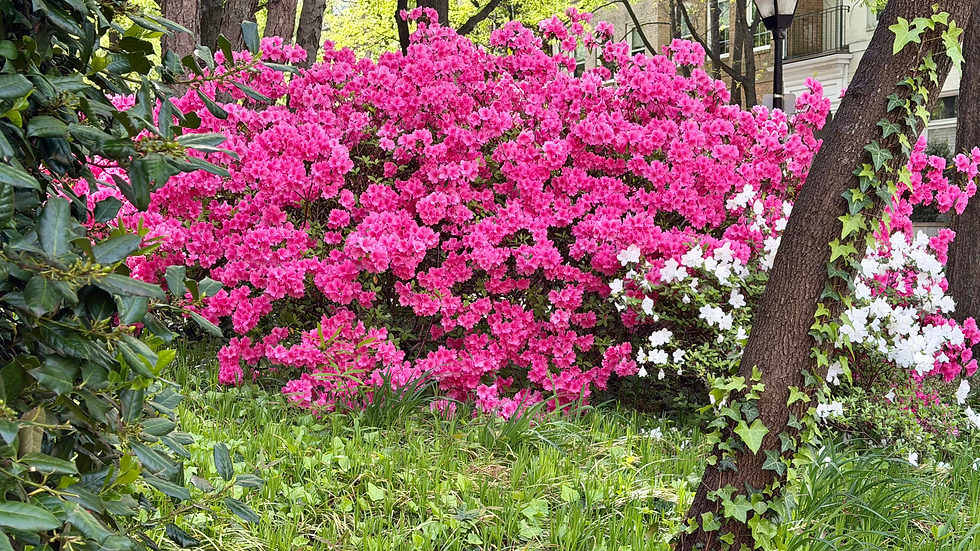
I did manage to capture this garden with azalea and other plants in their full spring regalia.
After being disappointed to find the Chrysler Museum closed, we walked back into downtown looking for lunch. We found an Irish pub and both ordered traditional Irish comfort food--in my case shepherd's pie. Just before lunch was delivered, I finally got a call from Craig Messick at Safe Harbor Bluewater's service yard. He listened to my problem, got his TravelLift operator, Derek, on the other line, and subsequently asked how soon I could be there. Music to my ears! I did a rough calculation and concluded we could be in Hampton by 2:30. "Bring her over" he said. I traded in my Smithwick's (only had had a sip) for a Diet Coke (I won't drink even a beer before operating the boat) and we both gulped down our lunches. We hoofed it back to the boat as fast as two septuagenerians could do it and prepared to make way.
Due to the speed limit in Norfolk Harbor, it took us about an hour and a half to travel the roughly 15 miles to Sunset Creek. Craig had asked me to call him a half mile out and, when I did, he said, "The lift is ready, drive right on when you get here."
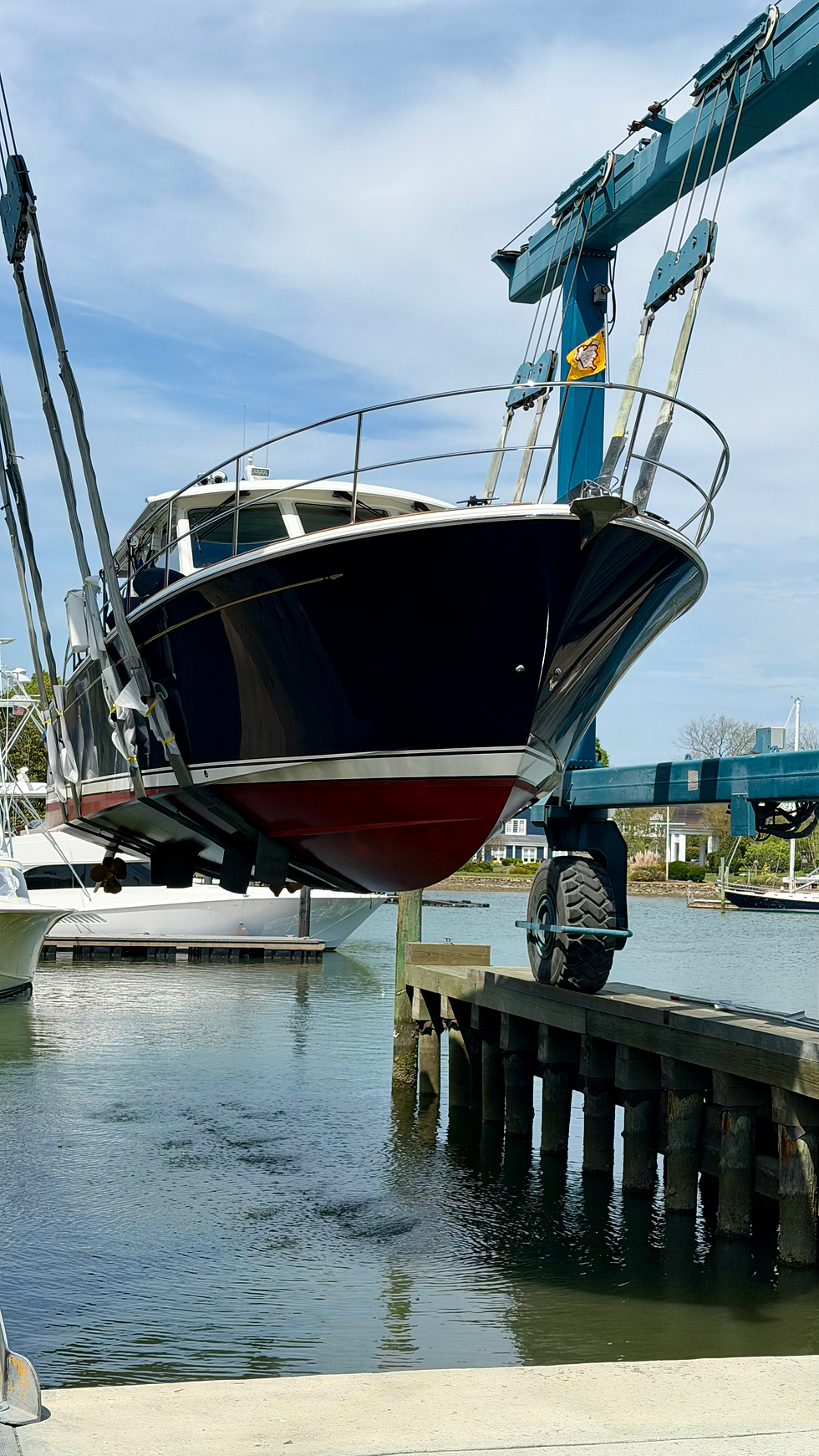
Once Katahdin was wheeled up onto dry land, it didn't take long to find the problem. The crimps on two hydraulic hoses had corroded and let go--not something that should happen on a piece of equipment less than a year old. Craig tried to procure replacement hoses from a local vendor but they didn't have the parts. However, Freedom Lift would overnight them from Michigan so we went back into the water for the night.

Tuesday morning, the parts arrived at about 10:30 and by noon time we were again on the TravelLift now getting repaired. Putting the four new hoses on was very straightforward. However, when the technician refilled and purged the hydraulic fluid reservoir, the system spewed a mixture of new fluid and a nasty emulsified combination of the former fluid and water. Yuck. That led to several hours and multiple fills and empties of the hydraulic system before the tech team deemed the job done. And even at that, they recommended that I do it again at the end of the summer. Sigh.

On the positive side of things, we are hoping that Freedom Lift will pay for this entire repair. They should. And, having your boat out of the water allows you to take a good look at her bottom. The hull was surprisingly clean with only a couple of minor bits of bottom paint missing. The props had no bends or dents and in general, their prop speed coating was in great shape. So, on we go. Yorktown next!


Comments