Safety on Katahdin
Disclaimah: This blog responds to requests from family and friends asking about the precautions we take to keep ourselves safe while traveling the Great Loop. I have studied and practiced boating nearly my entire life and have earned my US Coast Guard 25 Ton Masters License for Power and Sail. However, I do not pretend to be a boating safety expert and I most certainly do not profess that what we do and how we do it is the way that others should. Rather, these are approaches that we hope work for us given our experience and age.
Lifejackets: We each keep an emergency, off-shore life jacket beside our bed and an inflatable life jacket on the back of our helm chair. The ones beside the bed are there, in the very unlikely event, that we wake up in the night to a sinking boat.

The inflatables we actually wear multiple times on many days . Our practice is simple. Before we start to prepare the boat to depart (whether from a dock or the anchor), we don life jackets and head sets, aka marriage savers. We wear them until all lines are coiled, fenders are put away, the boat is aligned on its first course, and we are both safely in the salon. Similarly, before we prepare the boat for docking, we both put on our life jackets and marriage savers and we wear them until all lines are secure to the dock, final adjustments are made, and the power and shore water connections are hooked up.

We've learned over time that it's important for the helmsperson to keep his or her life jacket on until all getting underway or docking tasks are completed. While getting on course and reaching for the first sip of that second cup of coffee, the life jacket can seem extraneous--especially in a cabin that seems warm after being outside. We've learned, however, that numerous small incidents can cause the helmsperson and dock hand to need to change roles--sometimes when time is of the essence. So having that jacket on until the dock hand is back in the salon with all tasks completed just makes sense.
We also have a hard and fast rule that anyone going forward while underway, no matter how simple or short the task or how calm the water, wears a life jacket for the duration. Our rationale is simple. While underway in the salon, there is a miniscule chance of falling overboard; thus we do not require that jackets be worn there. While docking or casting off, however, we are on and off the boat--often several times. You could trip on a fender, get tangled in a line, get jounced by an unexpected wave, inadvertently fall through the space between the boat and dock, or simply suffer a moment of imbalance. Going forward underway has its own special risks. All of the same things and more hold true in locks and, whether or not the lock requires life jackets, we wear them for the duration of the process. No one expects to fall overboard and you seldom can grab a life preserver as you go (years ago, the Admiral was the exception who proved this rule). What's more, even if you are lucky enough that someone throws you a jacket, once you're in the water, they are very difficult to put on.
We also wear inflatable life jackets when using the dinghy. Getting into a small, tippy boat from a larger rocking or bouncing boat poses a real risk of falling in. We see the life jackets as good insurance for staying above water and getting back to the boat quickly. And, were you unlucky enough to get knocked unconcious on the way overboard, your partner can grab you with the boat hook and, together with the life jacket, keep your head above water until conciousness hopefully returns.
And our bottom line rule: If the Captain says wear a life jacket, you wear one. No questions asked; no answers given.
Tethers: Getting separated from your boat after falling off is a recipe for dying. Even in daylight, finding a small head in any sea challenges the best of skippers and crews. Tethers are perhaps much more important on a sailboat where you may more often go forward to adjust sails and rigging on a boat that heels significantly even in the normal course. However, we have them on Katahdin and, if it's at all rough or if a task will require focus that may distract from what's happening around you, we deploy them from our lifejackets when forward of the cockpit. Case in point, earlier this week, one of our windshield wipers failed at a time when we desperately needed a clear windshield to see crab pots and navigation markers. Even though Jackie slowed way down. the boat rocked and rolled and, needing both hands for my repir task, I was more than happy to be clipped in. Were I unlucky enough to go overboard, at least I would remain right beside the boat. No search necessary; only rescue.

Victim in the Water: Speaking of rescue, we have readily at hand throwable life cushions that not only offer at least a chance that a person overboard could grab on for additional buoyancy but also, if thrown quickly, help mark where the victim is. The captain will execute a Williamson turn to get the boat on as exact a reciprocal course as possible. Once the victim is located, we deploy a LifeSling--either by throwing it to a victim or by circling the victim as you would to get a line back to a waterskier.

Once the victim has it over his or her head, they can be pulled to the boat where they can hopefully use the swim ladder to climb back aboard. However, the combination of heavy clothing, cold water, and time of immersion quickly render a victim hypothermic and unable to get back aboard under their own steam. For that eventuality, we have 5 to 1 hoisting tackle connected to the coach roof which is designed to attach to the LifeSling. There are no guarantees that this will work--especially if the victim were heavy and there was only a much smaller person on board managing the rescue. Our systems are all designed to improve the odds; unfortunately they cannot guarantee success.
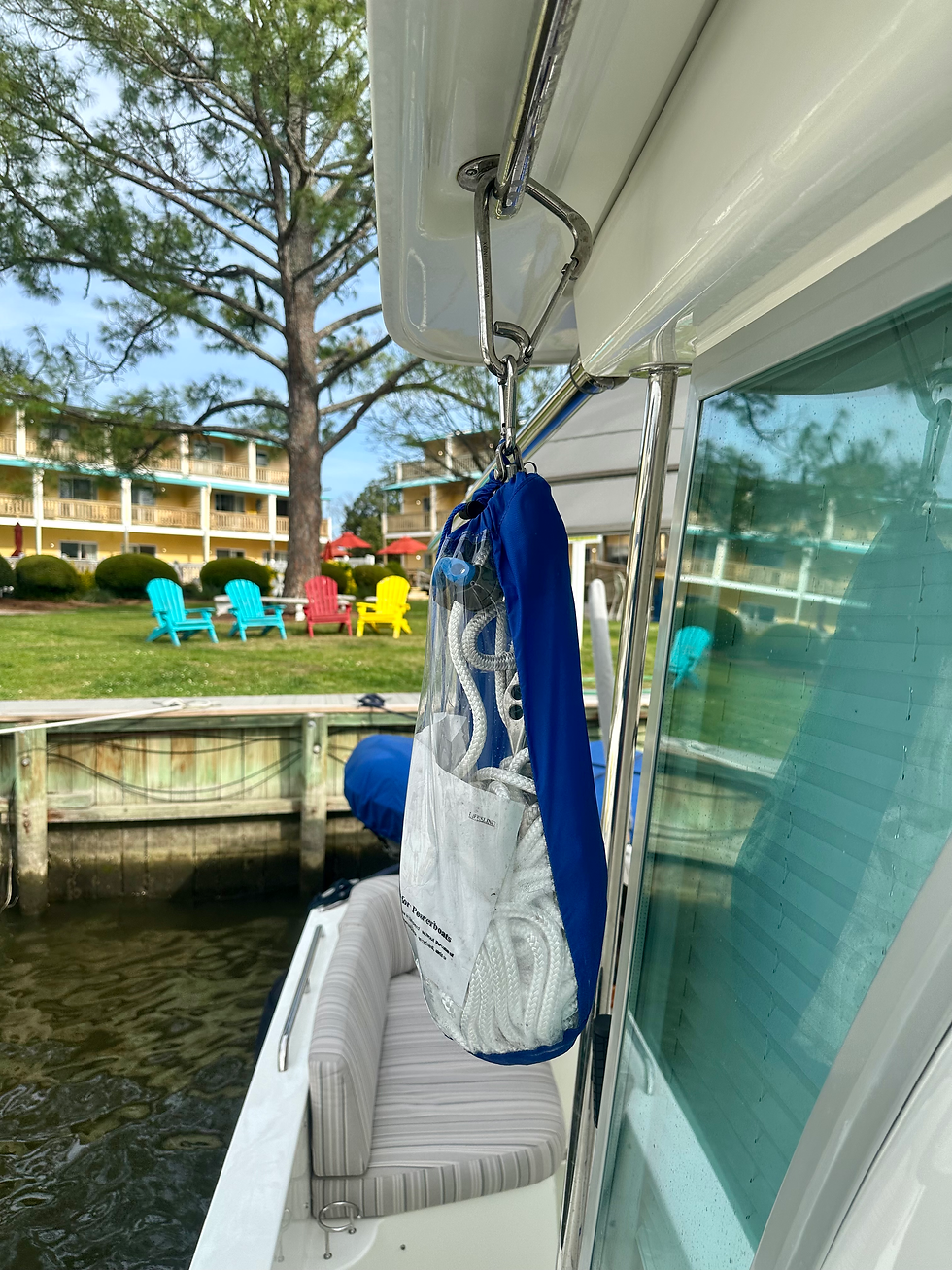
Fire: From time immemorial, catastrophic fire has plagued people of the sea and, in the age of lithium batteries, it has only become more prevalent. Only one or two videos of a modern boat going up in flames are enough to convince you that caution is needed. On Katahdin, we have a modern electrical system; her engine uses diesel which is much less explosive than gasoline, and we carry no propane, LNG, or the like. Of course we do have computers, iPads, cell phones and we do charge them overnight (we shouldn't). What wwe do do is monitor both the appliances and their chargers and we replace them if we notice them getting hot while charging.
On the defensive side, we carry five fire extinguishers. A large extinguisher should deploy automatically in the event of an engine room fire. It can be deployed manually as well. We carry two extinguishers in the cockpit--a large one in the open and one under the seat cushions. A fourth extinguisher resides adjacent to the helmsman's right calf and a fifth lives in the closet cabinet in the guest berth. We inspepct each of these once a year and, in addition, firmly shake the four portable units. We also have a fire blanket in the salon that can be used in a variety of situations but would be especially helpful with a grease fire.


Flood: Boats can flood for a variety of reasons. Surprisingly, one of the most common is a simple failure of a domestic fixture or PEX pipe joint. If that failure occurs when you are using your on board water tanks, things will get wet but you won't sink. You'll just have the weight of that water in different places. However, if it fails while you're connected to shore water and no one is around to see it, down she goes. We try to remember to shut the shore water off every time we leave the boat--even just for a quick meal in a marina restaurant. But, we forget more often than we should. Sometimes it's better to be lucky than good.
Of course you can also flood from burst engine hoses, broken through hull fittings, running aground, etc. We have four high water alarms on board to alert us and four bilge pumps (one forward, one aft, and two amidship) to delay sinking. I also carry a high capacity pool cover pump as a pump of last resort. None of these pumps nor all of them working together could keep up with a serious leak. We carry emergency bungs at every hose and through hull and a full damage repair kit with fabric, epoxy and other materials.
Here's praying we never have to use any of these.
Mechanical Failure: Long time readers will remember the scare we had on the Mississippi River when we thought our steering had failed. Engines, transmissions and electrical systems can also let you down. Of course, it's one thing if you're at the dock and quite another if you're in the Mississippi River, a busy harbor, or in a place where you are being blown onto a lee shore. We carry an anchor grossly over sized for Katahdin along with 150 feet of chain and 150 feet of line. We also carry a 32 pound anchor ring to further increase the anchor and rode's effectiveness by increasing the horizontal rather than diagonal pull on the anchor. Further, we carry and deploy a heavy duty anchor snubber that ties off to both bow cleats. This absorbs shock, reduces wear on the windless, but most importantly reduces the liklihood of a snapped chain, line, or connection. And, we have a second anchor and rode in the anchor well ready to go. Again, no guarantees, only calculated risk reduction.

Careful Planning: Finally, we use careful planning to reduce risk. Before each day's cruise, I carefully check the route for low bridges, locks, shoal areas, and tricky turns. I mark these with waypoints and also mark the final turn for our anchorage or marina so we won't inadvertently cruise by. Know where you're going! As we near our destination, the Admiral often calls the marina and figures out where our slip will be, what side of the boat we'll be tying up on, how high or low we'll want the fenders and what vhf frequency we will use to hale the marina. She then uses NEBO to get an aerial view of the marina and tries to educate me about how we'll prosecute marina entry and docking. She has a tough life.
Abandon Ship: I hope we never have to abandon ship. But, if we do, we'll activate our EPIRB, wear our heavy duty off-shore life jackets. grab our ditch bag (extra clothes and hats, portable gps and vhf, water, documents, etc.. We'll very loosely tie the dinghy's painter to the boat, cut loose it's cover and ties, and at the last minute before sinking cast off the ginghy.
Then, we'll hope.
There are a host of other things we do to ensure our safety underway. Monitoring fuel, keeping track of the engine guages, checking the weather, deploying the right signals in fog, sharing a float plan for off-shore excursions, and on and on. This is by no means a complete list but I hope the blog gives you a sense of some of the things we're thinking about every day.
And last but by no means least, wherever your travels take you, be careful, be safe.


Sounds VERY thorough and well thought out. I hate to think I'd have to know how to use all the items you have. Stay safe, and have fun!