Two, Hot Days on the Trent-Severn
- Chuck Hewett
- Jul 6, 2025
- 4 min read
Updated: Jul 11, 2025
We've had two hot, humid days on the Trent-Severn since my last post. Saturday, we traveled a little more than five miles from the Lock 8 wall to the Campbellford
town wall. Our trip included four locks including a flight of two, 24 foot locks that lifted us a total of 48 feet surprisingly quickly.

As we approached Campbellford, the largest antique car show the Admiral and I have ever seen lined the west bank of the river. Car after car after car with little space between them showed off their history and wax jobs for nearly two miles along our route. Of course, that made for a very crowded Campbellford.

The Campbellford town wall offered 50 amp power service and shore water hookups--both very helpful on an afternoon when the temps reached 90.
Once we got tied up, I hoofed it over the bridge and down the river to Canadian Tire--my first experience there. They say it has everything; it does. For me, I needed a rotor rooter to clean out the drain line on the guest shower--despite the fact that I'm the captain, my shower. Found it. In fact, not being exactly sure what I'd need, I found two. Turns out the short, cheap, five foot long item did the trick. It pushed a great big hair ball out of the line and into the sump from which a pump pushes shower water overboard. It wasn't fun mucking around in the sump with my hand but I captured the hairball and a few other goodies and pulled them out. Problem solved!
Campbellford is a small town in a rural setting. Founded in 1906, it has an impressive town hall. And the Royal Canadian Mint named Bellford the Home of the Two Dollar

Coin in 1997. In Campbellford, Brent Townsend created the iconic polar bear image that appears on the tails side of the Toonie. Campbellford's Toonie monument stands 27 feet high and reaches 18 feet in diameter. We docked just across the river from it.

Today (Sunday, July 5), we traveled through six locks over 20 miles. Wanting to be first in line at the first lock about 2 miles upstream from the Campbellford wall, we organized early and left the dock about 7:45. We reached lock 13 about 8:00 and were, indeed, first on the blue line for the lock's 9:00 opening. Two more boats joined us there, the first of which locked through five of today's six locks with us. As they did yesterday, heat and humidity made tending the lines in the locks a bit of a chore--especially for the Admiral. We ran the generator and air conditioning most of the day to provide a

cool breather between locks. In lock 15, however, the lock keeper chastised me for leaving our generator running. Apparently, despite the fact that we have an underwater exhaust discharge, that's as much of a no-no in Canadian locks as leaving your engines on. Shame on me. After that, we got pretty good at turning the AC and generator off after we secured ourselves in the lock and turning them back on just before we restarted the engines to exit the lock.
We traveled today through a contrast of shorelines--some heavily developed with camps and second homes and others undeveloped, much of which were wetland. Cruising along the lakes, rivers, streams and ponds, we saw a couple of kingfishers, favorites of mine, numerous great blue heron, osprey, and, best of all, an otter swimming across the river in front of us. Most if not all of the locks and dams had power stations generating "hydro" for the grid. I particularly liked the station shown below which I think was at lock 15.
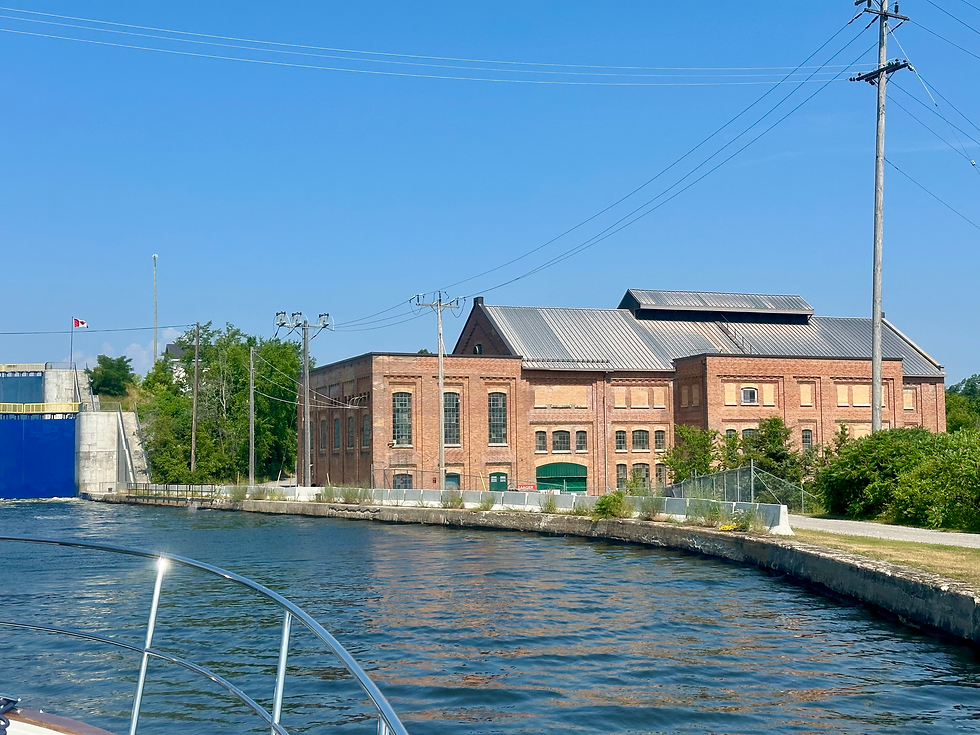
That brings us to a brief discussion of the Trent-Severn Waterway which connects Georgian Bay on Lake Huron to Trenton on Lake Ontario. Unlike the Rideau Canal which the military built in one, coordinated construction project from 1826 to 1831, fate caused the Trent-Severn to be built as a hodge podge. With the first lock constructed in the middle of what is now the Waterway in 1837 as a commercial venture, the last lock wasn't built until nearly a century later when the final stretch to Trenton was completed in 1920. The first complete transit of the Waterway took place in July of that year. During that time, the military abandoned its interest altogether and rail, road and large steamships on the great lakes displaced the utility of the Waterway as a commercial venture. As motor boating surged during the first half of the twentieth century, the Trent-Severn became a pleasure boating route, one of Ontario's major tourist attractions, and a critical link on America's Great Loop. Winding through the cottage country of Ontario north of Toronto, it has become a boating gem. We're enjoying it.


Comments